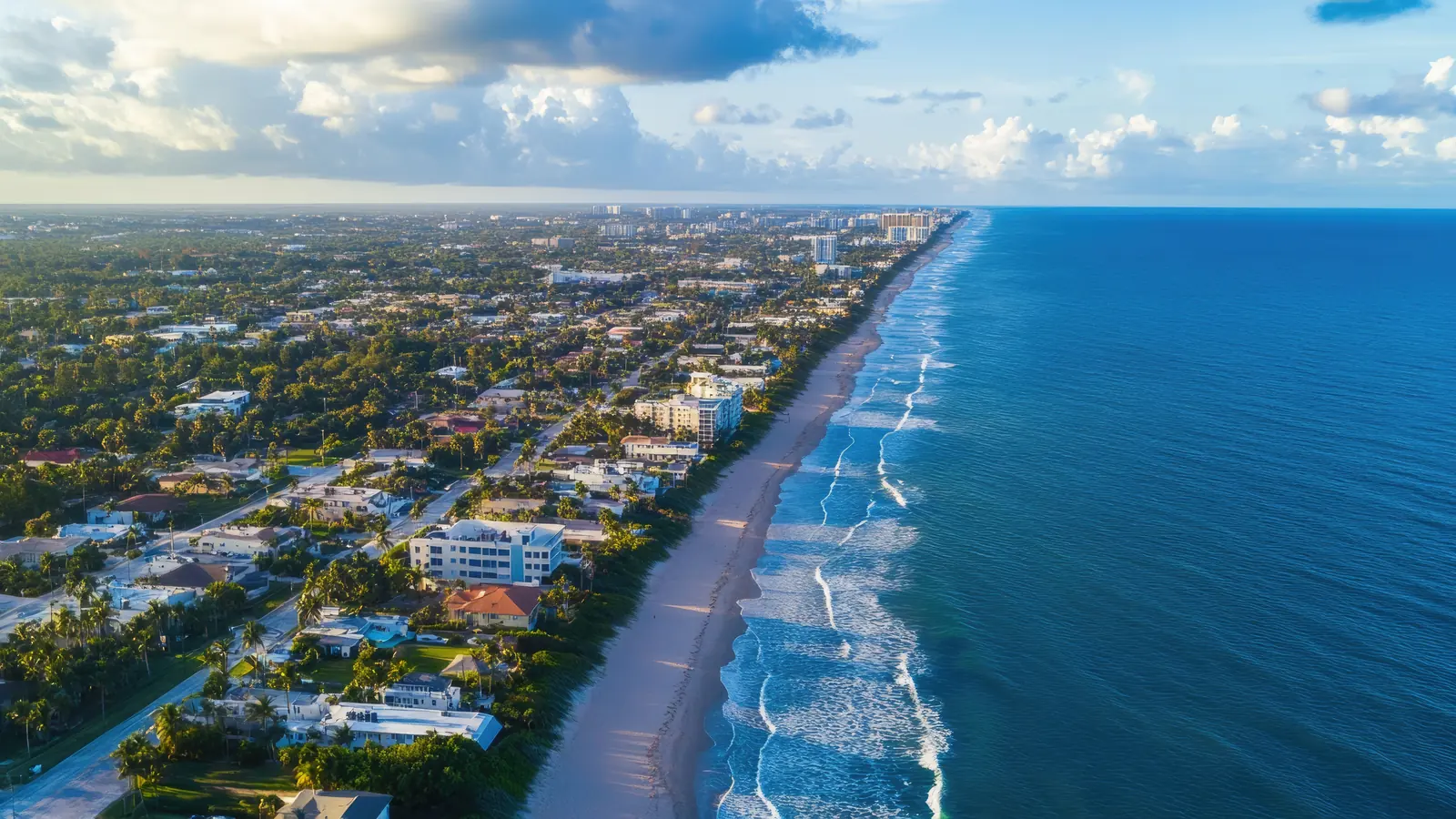
Almost every Delray Beach listing near downtown says some version of “walk to Atlantic Avenue.” It is the most repeated phrase in the market and the least examined. Two houses can both be a ten-minute walk from the same restaurant and be worth meaningfully different money, because walkability here is not a radius drawn on a map.
The premium is directional, not a radius
Atlantic Avenue runs east and west, from the Intracoastal bridge out to A1A and the sand. That single line is what downtown Delray is organised around, and the value attached to it does not decay evenly in all directions.
Move east or west along the Avenue and you stay on the spine: the shops, the restaurants and the sidewalk life continue with you. Move north or south, even by the same number of feet, and you leave the spine after a block or two. Residential streets a short walk off the Avenue are quieter and less expensive than an address on it, and that gap opens up much faster than distance alone would suggest. This is why a listing that quotes you a walking time is telling you very little. The direction of the walk matters more than its length.
The same logic applies to the north–south cross streets that carry their own activity. Pineapple Grove runs north off the Avenue as its own small district; Swinton Avenue runs north and south past Old School Square with the historic core on either side. Being on one of those is different from being on a residential street that merely crosses them.
Where the noise trade-off flips
The blocks with the highest walkability premium are also the blocks with a Saturday night. Downtown Delray carries a genuine restaurant and bar economy, and the closer you are to it, the more of it you hear — not usually from the venues themselves, but from the street outside them at closing time, and from the traffic and parking that come with them.
Somewhere within a few blocks of the Avenue, those two curves cross. The premium for proximity is still real, but the cost of proximity has started rising faster than the benefit. Where exactly that happens depends on the street, what sits between it and the Avenue, and how the building is oriented. A house shielded by a block of low commercial buildings behaves differently from one with an open sightline down to the noise.
Buyers who spend a season here almost all arrive at the same personal answer: close enough to walk to dinner, far enough to sleep. The disagreement is only ever about which street that is, and no listing description will tell you.
“Walk to the Avenue” and “walk to the beach” are two different walks
These get used interchangeably and they are not the same claim. The Avenue crosses the Intracoastal on a bascule bridge before it reaches the ocean, which means a walk to the beach from anywhere west of the waterway includes a bridge that opens for boat traffic on a schedule you do not control.
It is a pleasant walk and people make it daily. But if the thing you are buying is beach access on foot, the waterway is a real feature of the route, and a property east of the Intracoastal is buying something a property west of it cannot. Establish which of the two walks a listing actually means before you price it in.
What the historic districts change
Several of the neighbourhoods immediately around downtown sit in designated historic districts. That brings mature tree canopy, older housing stock and streets that were laid out before the car — much of what makes the area walkable in the first place.
It also brings review. Exterior changes to a contributing property in a historic district generally require approval, and what you may do to a facade, a roofline or a street-facing addition is narrower than elsewhere in the city. For a buyer who wants the house as it stands, that protects the very thing they are paying for. For a buyer planning to reshape it, it is a constraint worth understanding before the offer, not after.
How to test a block before you offer
- Walk it at the hour you would actually be home — a Friday at ten in the evening tells you something a Tuesday at noon cannot
- Walk the route to the Avenue, not the distance to it, and notice what you cross
- Establish whether “walk to the beach” includes the bridge
- Check where the nearest public parking sits and how it empties at closing time
- If the property is in a historic district, confirm what exterior work requires approval before you plan any
Delray rewards this kind of specificity more than most markets, because so much of its value is concentrated along one street. A portal can show you every listing within a mile of Atlantic Avenue. It cannot tell you which side of the trade-off each one sits on.