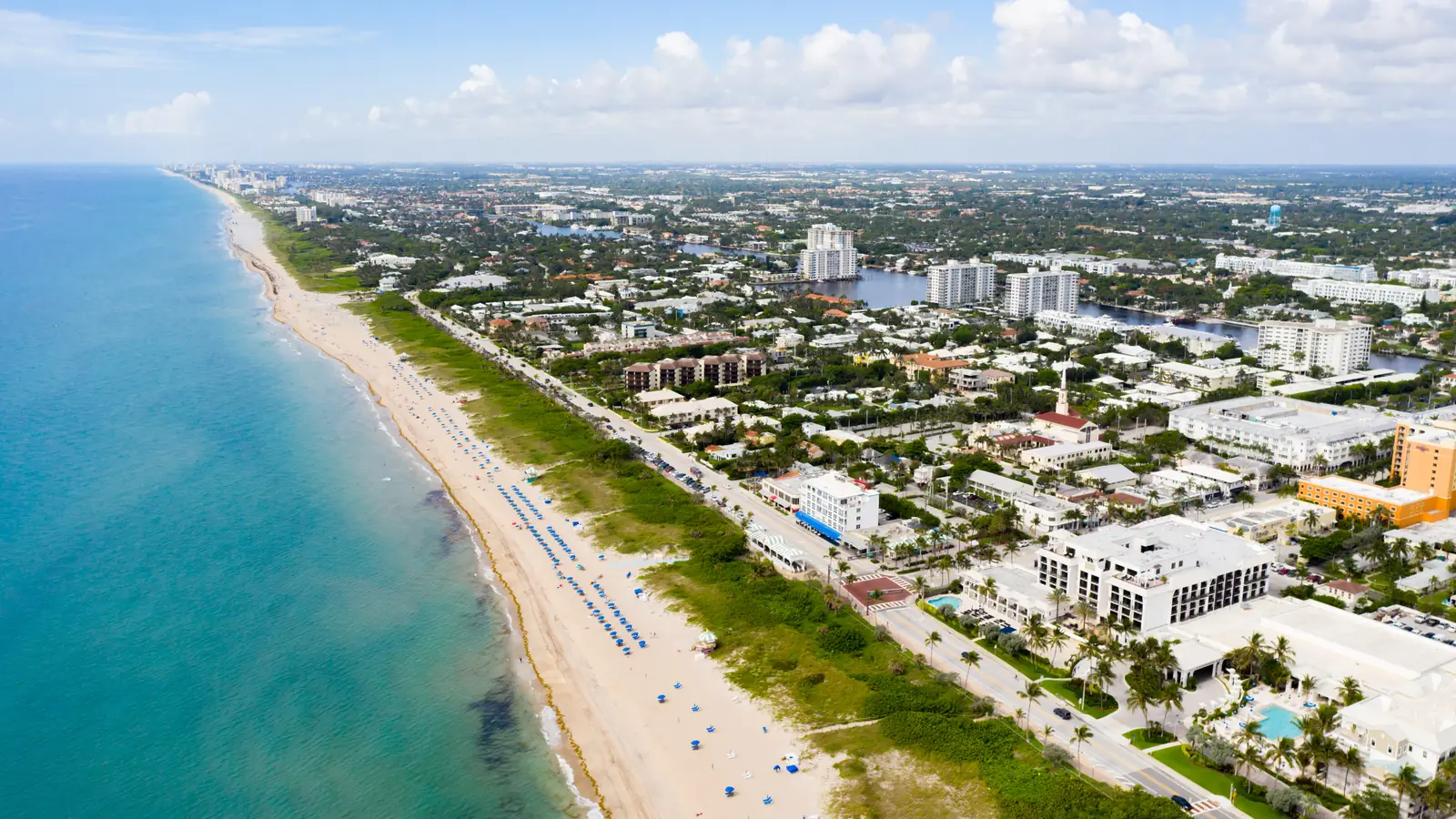
Highland Beach is a barrier-island town about one road wide. The Atlantic is on one side of State Road A1A and the Intracoastal Waterway is on the other, and that geography does almost all of the work in this market. Before price, before building, before anything else, a Highland Beach property is either ocean side or Intracoastal side — and the two are buying different things.
What each side actually buys
Ocean side buys the beach and the morning. Depending on the property that means direct frontage, a private crossover, or an ocean view from a tower, and the sound of surf rather than boat traffic. What ocean side cannot buy is a dock. There is nowhere to put one.
Intracoastal side buys the water you can use. Dockage, a boat lift on some properties, protected water, and the sunset over the waterway rather than the sunrise over the ocean. What it does not include automatically is the beach. Getting to the sand from the west side of A1A means crossing the road, and the right to do that — and to use whatever is on the other side — is a legal question, not a geographic one.
“Deeded beach access” is not one thing
This phrase appears constantly in barrier-island listings and it covers arrangements that differ enormously. It is worth slowing down on, because two properties advertising the same words can be offering very different rights.
At one end is an easement appurtenant — a recorded right that runs with the land, passes automatically to you at closing and to the next owner after you, and cannot be casually withdrawn. At the other end is a membership or a licence: a permission to use someone else's facility, which may carry dues, may have conditions, and may be revocable or terminable on terms buried in a document nobody hands you.
Between those sit shared crossovers owned by an association, arrangements where a specific number of units share a facility, and rights that exist but are limited in ways that matter in practice — the crossing but not the cabana, the sand but not the parking, daytime but not evening.
So the useful question is never “is there beach access?” It is: what document creates it, is it recorded, does it run with the land, what exactly does it let me use, what does it cost annually, and who maintains the crossover and pays when a storm takes it out? That last one is a real expense on this coast and it lands somewhere.
The bridges decide what the dock is worth
An Intracoastal-side dock in Highland Beach is subject to the same rule as anywhere else on this waterway: the boat you can keep on it is limited by what sits between the slip and the ocean. Highland Beach has no inlet of its own, so reaching open water means running north or south along the Intracoastal to one, and passing whatever crossings lie in between.
This is worth establishing early and precisely, because it is priced into the property whether or not the listing mentions it, and it is the sort of thing buyers discover after closing. Which inlet you would actually use, what stands between your slip and it, and what that means for air draft is a short piece of homework with a large effect on what the dock is worth to you.
Almost everything here is a condominium, and that has consequences
Highland Beach's housing stock leans heavily toward mid-rise and high-rise condominium buildings, many of them built decades ago, along with a smaller number of single-family homes on both sides of A1A.
For an older coastal building in Florida, the structural inspection regime and reserve rules now do more to determine what a unit is worth than the finishes do. The building's inspection status, the state of its reserves, and any open or contemplated assessment are the first documents to read, not the last. On a barrier island, where buildings take salt air and storm exposure continuously, this is not a formality.
Which side suits which buyer
- You want the beach as the daily fact of living here — ocean side, and establish whether frontage means private or shared access
- You keep a boat and use it — Intracoastal side, and settle the bridge question before you price the dock
- You want both — Intracoastal side with a strong, recorded beach access right is the usual answer, and the strength of that right is the whole negotiation
- You want quiet and low maintenance — a well-run building on either side, chosen on its reserves rather than its lobby
Before you offer
Read the instrument that creates the beach access, not the listing's summary of it. Establish what the association owns on the ocean side and what it merely has permission to use. Get the reserve position and the inspection status of the building. And walk across A1A at the point you would actually cross it, at the hour you would actually cross it — a right of access and a pleasant daily walk are two separate things, and only one of them is written down.