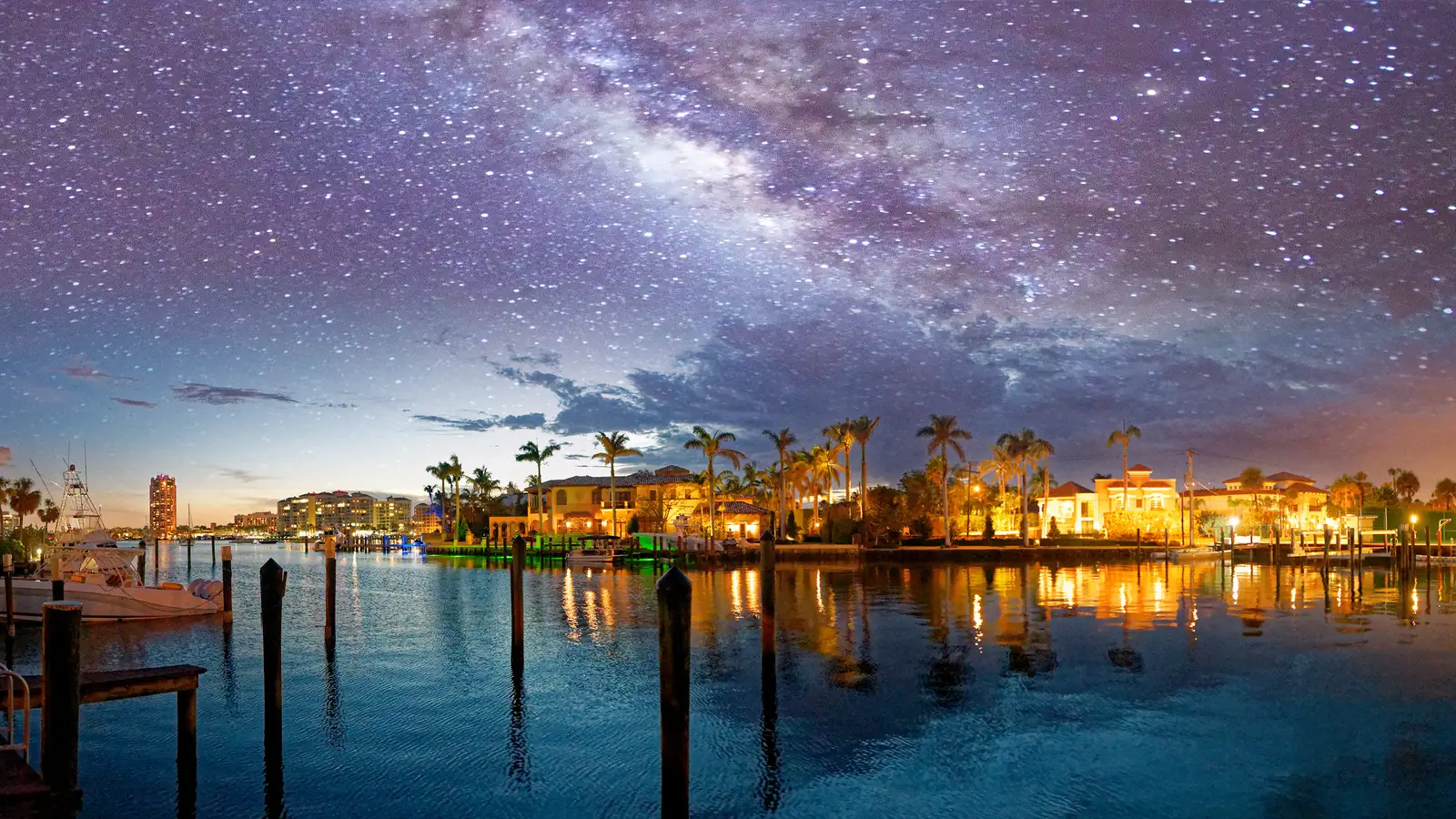
"Deeded dock" and "direct Intracoastal access" are two of the most valuable phrases in a South Florida listing, and two of the least examined. A dock is only worth what you can keep on it, and what you can keep on it is decided by structures you do not own and cannot change.
Why the bridges decide the value, not the dock
To use a boat you have to reach the ocean, which means running the Intracoastal until you reach an inlet. Between your slip and that inlet sits some number of bridges. Each one is either a fixed bridge, which never opens, or a movable bridge — usually a bascule — which does.
A fixed bridge sets a hard ceiling. Its clearance is the maximum air draft that can pass beneath, and no arrangement with anybody changes that. If a fixed bridge with modest clearance sits between you and the inlet in both directions, the property is a small-boat property no matter how impressive the dock is.
This is why two houses on the same waterway, a few hundred metres apart, can carry very different prices. One is on the ocean side of a limiting bridge and one is not. Nothing about the houses explains the gap.
Air draft is not the same as your boat's advertised height
Air draft is the distance from the waterline to the highest fixed point on the vessel — usually an antenna, a radar arch, a hardtop or an outrigger. It is not the number in the brochure, and it is not fixed: it changes with fuel, water, gear and passengers.
Clearance is not fixed either. Charted bridge clearance is quoted at mean high water, so real clearance varies with the tide and, at times of year with higher tides, can be meaningfully less than the number on the chart. Anyone planning to transit with only inches to spare is planning to eventually not transit.
The practical version: leave real margin, and treat the charted number as the optimistic case rather than the guaranteed one.
Bascule bridges are better, but they are not free
A bascule bridge opens, so it does not cap your air draft. What it costs you is time and predictability. Many operate on a published schedule rather than on demand, which means departures and returns get planned around openings. If you intend to use the boat casually — an hour before dinner — a restricted-schedule bridge changes the experience more than buyers expect.
It is worth checking the current operating schedule of every bridge on your likely route rather than assuming on-demand opening. Schedules are set by regulation and they do change.
The inlets are part of the same question
Reaching an inlet is not the same as being able to comfortably use it. Inlets on this coast differ considerably in width, depth, current and how they behave in a wind against an outgoing tide. Some are straightforward in most conditions; others are genuinely demanding and are treated with respect by people who run them every week.
So the honest question is not "how far is the inlet" but "which inlet will I actually use, how many bridges are between me and it, and what are they". Two properties equidistant from the water can answer that very differently.
What to establish before you price the dock into an offer
- Which inlet you would realistically use, and the route to it in both directions
- Every bridge on that route, and whether each is fixed or movable
- The charted clearance of each fixed bridge, understood as a mean-high-water figure rather than a guarantee
- The current operating schedule of each movable bridge
- Your real air draft, measured with the boat loaded the way you use it
- The controlling depth at the dock at low tide, not just at the waterway
- Whether the dock, lift and seawall were permitted, and their condition and age
- Who maintains the seawall, and whether any repair obligation is shared
The seawall is the part people forget
Dockage attracts all the attention and the seawall behind it quietly carries the larger financial risk. Seawalls have finite lives, replacement is expensive, and a failing one is not always obvious to someone standing on it. On a canal property this deserves its own inspection by somebody who does marine structures, not a general home inspector working through a checklist.
How this shows up in pricing
Where I can be useful is in separating the three things that get bundled together as "waterfront": frontage on water, usable dockage, and unrestricted ocean access. A property can have the first without the second, and the second without the third. Those are three different prices, and listings do not reliably distinguish them.
If you tell me the address, I will tell you which of the three it actually has, and what that is worth on that particular canal. That is a specific answer, and it is the only kind worth having here.